AI 提示词
Ancient Chinese Naval Warfare Infographic — Sora 2 Prompt
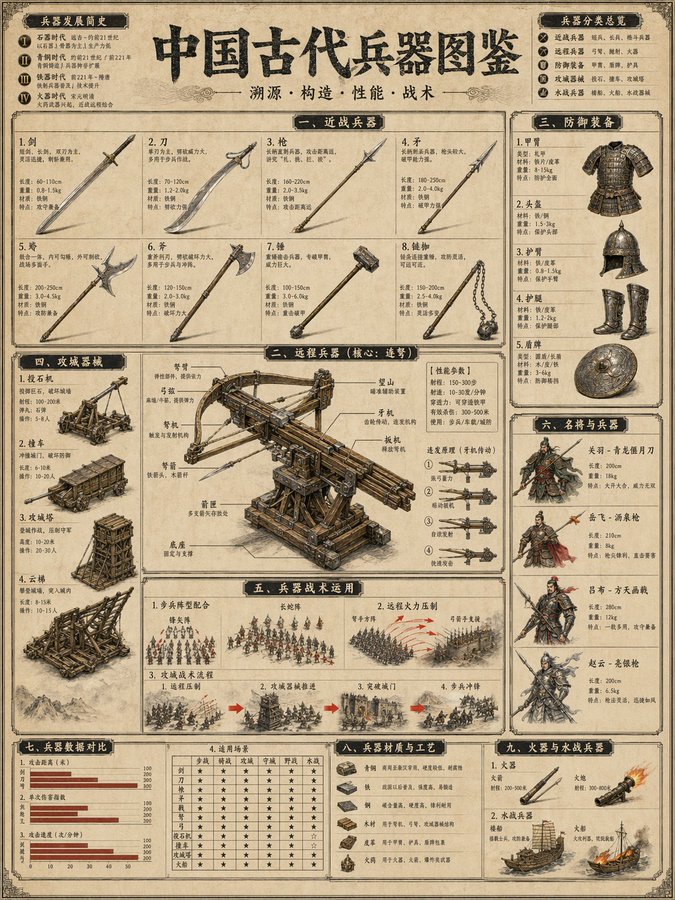
Generate a breathtaking technical infographic blending traditional Chinese gongbi line-art with modern tactical blueprints on aged parchment.
1 / 2
提示词 · EN
A breathtakingly intricate masterpiece technical infographic of [SUBJECT / 例如: Ancient Chinese Naval Warfare], strictly designed based on the following first-principle visual parameters. [CANVAS & COLOR DICTATORSHIP] BASE CANVAS (L0): Aged military parchment texture, warm #E8DCC4, with subtle weathered stains and historical map fiber textures. SYSTEMIC COLOR (L1, ~60%): Traditional heavy charcoal ink #2B2B2B for structural technical lines, soldier silhouettes, and mechanical joinery. CONTENT TIER COLOR (L2, ~30%): Weathered bronze, dark lacquer red, and iron gray #555555 to distinguish between different units and materials. ACCENT COLOR (L3, ~5-10%): High-visibility Vermillion #E62B1E reserved ONLY for tactical arrows, fire/explosions, and commanding general banners. [SPATIAL GRAVITY & TOPOLOGY] COMPOSITION: [选择一个: 主从卫星布局 / 45度等轴测全景]. Information gravity flows in a logical tactical sequence. BOUNDARIES: Professional editorial layout with clean margins; negative space serves as “tactical breathing room” to separate different combat phases. MODULE TOPOLOGY: [N] distinct information modules depicting different scales (e.g., individual weapon detail vs. macro formation). [DIMENSIONALITY & GRAPHIC PHYSICS] STYLE: Fusion of Traditional Chinese Gongbi (meticulous line-art) and modern military tactical blueprints (like “Osprey Publishing” style). LINE LANGUAGE: 0.8pt sharp technical outlines / 0.3pt faint background grid lines / 2pt bold borders for the main title seal. SURFACE EFFECTS: Realistic material rendering — wood grain on ballistas, metallic sheen on lamellar armor, and subtle ink-wash shading for terrain. [TYPOGRAPHY ECOSYSTEM — ADAPTIVE DENSITY] TYPOGRAPHY DENSITY: Map-dominant (65% visual / 35% text). T1 MACRO HEADER: Massive, ultra-bold Traditional Songti characters for the main title “[主题中文名]”. MUST be strictly pure Chinese Hanzi with an ink-pressed texture. T2 MODULE HEADERS: Kaiti font enclosed in dark rectangular “military rank” badges, labeling different tactical zones. T3 BODY TEXT: Clean, medium-weight Heiti (sans-serif) for weapon specifications and tactical roles. Every character must be razor-sharp. T4 ANNOTATIONS: Micro-text with ultra-crisp technical lines pointing directly to components (e.g., trigger mechanism, fletching, armor joints). [NARRATIVE FLOW] NARRATIVE MODE: [选择一个: 流程顺序型 / 核心辐射型]. VISUAL ENTRY POINT: The most significant tactical unit (e.g., the command chariot or the primary siege engine). PATH MECHANISM: Numerical sequence (1, 2, 3…) or bold cinnabar-red arrows guiding the viewer through the battle logic. [ICONOGRAPHY & METAPHOR] ICON STYLE: Highly detailed historical pictograms for units (infantry, cavalry, archers). CORE METAPHOR: Military order as a precise clockwork mechanism. CONSISTENCY: All symbols must adhere to the [时期/王朝, 如: Tang Dynasty] military aesthetic. [MODULE STRUCTURE — SUGGESTED BLOCKS] [MOD 1: CENTER-PIECE] — The primary [Weapons/Formation] with an exploded-view detail showing internal mechanics. [MOD 2: TACTICAL MAP] — Top-down schematic showing unit movement and line-of-fire. [MOD 3: SOLDIER EQUIPMENT] — Close-up side-by-side comparison of offensive vs. defensive gear. [MOD 4: LOGISTICS/STATISTICS] — Small icon-based charts showing range, weight, or troop density. [FINAL EXECUTION LOCK] Render as a single, ultra-detailed educational plate. All visual systems must be internally consistent with a professional museum archive aesthetic. Every pixel must serve the purpose of clarifying complex military history. Resolution target: Maximum information density, print-ready encyclopedia quality. 主题:中国古代兵器图鉴 3:4 4k文字清晰可读
关于这个提示词
Generate a breathtaking technical infographic blending traditional Chinese gongbi line-art with modern tactical blueprints on aged parchment. 它更适合作为 AI 模型 的概念艺术起点:先保留画面结构、主体关系和风格约束,再替换成你的品牌、人物或场景。
常见用途包括 chatgpt、兵器谱、古风志、蓝图纸。这些标签只作为创作方向参考,实际生成时仍应以提示词结构和预览图为准。
使用时建议先小幅修改主体、场景、镜头和色调,再生成多个版本对比构图与细节。这样页面内容对用户有实际帮助,也避免把模型名或标签机械堆在正文里。
如何使用这个提示词
- Copy the prompt text.
- Open your preferred AI image generation model (e.g., DALL·E, Midjourney, Sora).
- Paste the prompt and replace
[SUBJECT]with your desired topic, such as "Ancient Chinese Naval Warfare". - Adjust visual parameters if needed (e.g., color scheme, layout).
- Generate the image and refine with iterations.